Welcome to Web-site of The Nordic Concrete Federation (NCF)

Welcome to Web-site of The Nordic Concrete Federation (NCF)

We have the pleasure to welcome you to the Web-site of the Nordic Concrete Federation (NCF).

The Nordic Concrete Federation (NCF) is a collaboration organization of the concrete associations in the five Nordic countries, Denmark, Finland, Iceland, Norway and Sweden.

NCF is publishing bi – annually publications (NCR) and proceedings from Nordic workshops. Previously issues will you find under publications.

This website contains no informations of the national activities of each nordic countries.
Please go to each national sites for more informations.
New edition of the Nordic Concrete Research Journal

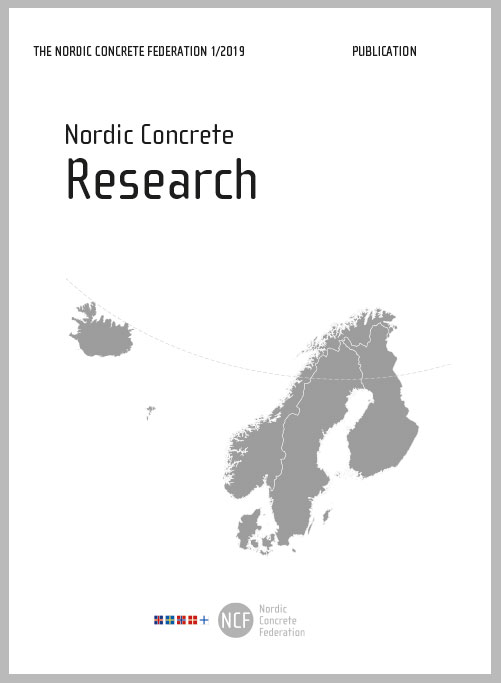
Check out issue 74 of the NCR journal. This issue of Nordic Concrete Research contains seven articles and shows the breadth of ongoing research in the field of concrete in the Nordic region. The articles cover a wide range of topics, including concrete with slag, concrete with wheat husk ash, CO2 absorption through carbonation, self-healing… Continue Reading

NCF Board Meets in Stockholm for Annual Meeting

On 29 April, the Board of the Nordic Concrete Federation (NCF) gathered in Stockholm for its annual board meeting. Representatives from Sweden, Denmark, Finland, and Norway came together to discuss key issues and strengthen Nordic cooperation within the concrete sector. The meeting was chaired by NCF President Berit Gudding Petersen of Norway. Hosted at the… Continue Reading

RCNCF Meets in Stockholm to Discuss Nordic Research, Development, and Education

On 28 April, the Research Council to the Nordic Concrete Federation (RCNCF) met in Stockholm to discuss current Nordic topics related to research, development, and education within the concrete sector. Representatives from all five Nordic countries attended the meeting, ensuring broad participation and valuable exchange of experiences from across the region. The meeting was chaired… Continue Reading

Check out NCR issue no. 73!

Two times a Year a new issue of NCR journal is published. The December 2025 issue is now availeable. 2025 was a strong year for Nordic Concrete Research. The year was marked by growing interest and a significant increase in the NCR Journal. Over the past year, the journal published 20 peer-reviewed papers: two from… Continue Reading

New edition of the Nordic Concrete Research Journal

Check out issue 74 of the NCR journal. This issue of Nordic Concrete Research contains seven articles and shows the breadth of ongoing research in the field of concrete in the Nordic region. The articles cover a wide range of topics, including concrete with slag, concrete with wheat husk ash, CO2 absorption through carbonation, self-healing of cracks, repair with UHPC, statistical methods to assess the strength of existing hollow slabs, and the possibility of cleaning swimming pools with ultraviolet light instead of chlorine, so that reinforcement is less corrosion-loaded. NCR Journal no 74 can be found here and the articles can be downloaded and read for free. We recommend, for example, Malena Thomassen and Ingrid Lande‘s article Identifying the Challenges of Large-Scale Adapting of UHPFRC to Use in Bridge Repair in Norway

NCR is published twice a year and the deadline for submitting articles for the December issue is 30 September. Read about deadlines and requirements for submission.

NCF Board Meets in Stockholm for Annual Meeting

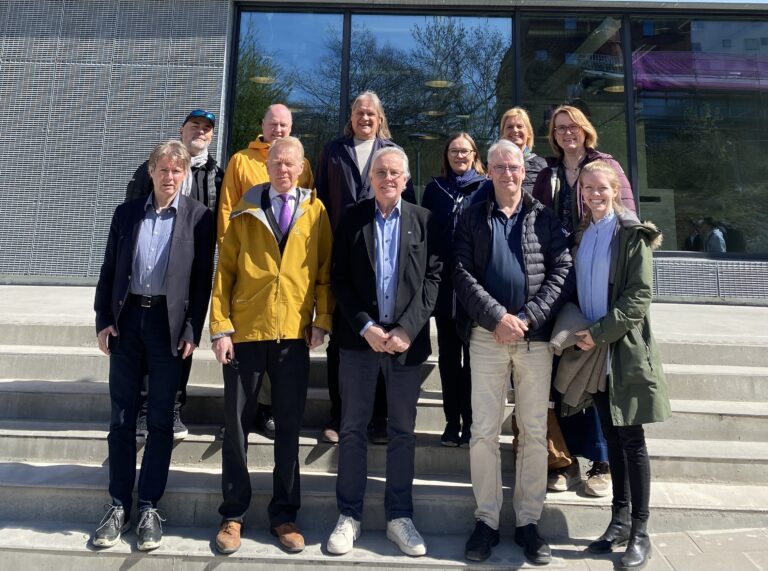
On 29 April, the Board of the Nordic Concrete Federation (NCF) gathered in Stockholm for its annual board meeting. Representatives from Sweden, Denmark, Finland, and Norway came together to discuss key issues and strengthen Nordic cooperation within the concrete sector.

The meeting was chaired by NCF President Berit Gudding Petersen of Norway. Hosted at the Royal Institute of Technology (KTH), the meeting provided an excellent setting for productive discussions and strategic planning.

The local hosts in Stockholm, Richard McCarthy, Mikael Hallgren, and Johan Silfwerbrand, ensured that all arrangements were in place for a successful and well-organized meeting.

A key focus of the agenda was the continued development of NCF’s joint Nordic initiatives. Among these, the Nordic Concrete Research Journal remains an important platform for sharing research and knowledge across the region. The Board also discussed webinars, workshops, and other professional activities aimed at fostering collaboration and knowledge exchange among Nordic concrete professionals.

The exchange of experiences and information on current topics in the different Nordic countries is a vital part of NCF’s mission. During the meeting, board members shared updates on ongoing developments, challenges, and opportunities within their respective national concrete sectors. Such discussions help identify common priorities and strengthen cooperation across the region.

As a platform for Nordic collaboration, NCF plays an important role in bringing together researchers, practitioners, and industry representatives. The annual board meeting in Stockholm once again highlighted the value of this cooperation and the shared ambition to further develop initiatives that benefit the Nordic concrete community.

RCNCF Meets in Stockholm to Discuss Nordic Research, Development, and Education

On 28 April, the Research Council to the Nordic Concrete Federation (RCNCF) met in Stockholm to discuss current Nordic topics related to research, development, and education within the concrete sector. Representatives from all five Nordic countries attended the meeting, ensuring broad participation and valuable exchange of experiences from across the region.

The meeting was chaired by Jouni Punkki of Finland, while Johan Silfwerbrand hosted the event at the Royal Institute of Technology (KTH) in Stockholm. The venue provided an excellent setting for constructive discussions and collaboration among the participants.

A key topic on the agenda was the operation and future development of the Nordic Concrete Research (NCR) Journal. RCNCF held productive discussions on the journal’s follow-up and management, including its business model and a number of practical matters related to its publication and long-term sustainability. The journal continues to play an important role in disseminating research results and strengthening cooperation within the Nordic concrete community.

The council also discussed current and potential joint Nordic projects, as well as topics of common interest that could benefit from increased collaboration across national borders. Particular attention was given to opportunities for knowledge sharing through workshops and webinars, including discussions on the frequency and format of such activities to ensure continued engagement within the Nordic network.

The meeting once again highlighted the value of Nordic cooperation in advancing research, innovation, and education in the field of concrete. Through regular dialogue and collaboration, RCNCF continues to support the exchange of knowledge and the development of initiatives that benefit the entire Nordic concrete sector.

Mette Rica Geiker was awarded the NCF Medal.

Mette Rica Geiker was awarded the honorary Nordic Concrete Federation Medal for her significant contributions to concrete research and education throughout her career.

The Nordic Concrete Federation Medal is given as a personal distinction for exceptional contributions to the scientific or practical development of concrete technology in the Nordic countries. In particular, contributions that have promoted Nordic collaboration are to be recognized.


Katrine Mürer Stemland received the Best Paper Award.

Katrine Mürer Stemland was awarded the Best Paper Award for the article ‘Load Effects of ASR-induced Expansion in Reinforced Concrete and Their Consequences for Structural Assessment’. The article is published in Nordic Concrete Research, no. 68, 2023.

The Nordic Concrete Research Best Paper Award is presented every three years at the Nordic Concrete Research Symposium. The prize is awarded to young researchers for an article published in the Nordic Concrete Research Journal between two symposia. The evaluation of the articles emphasizes novelty, research methodology (adequacy and execution), as well as the authors’ communication skills.

Katrine received the Best Paper Award with the following citation: The paper stands out for its relevant topic with high practical value, thorough research, and clear presentation.

Stefan Jakobsen received recognition from NCR editor Johan Silwferbrand for having completed the highest number of peer reviews during the period.

Successful Nordic Symposium in Sandefjord!

The Norwegian Concrete Association hosted The XXV Nordic Concrete Symposium in Sandefjord from 19–22 August.

The symposium program was very full, but still allowed time for questions and discussions, and there was strong engagement throughout all the days. The head of the organizing committee, Terje Rønning, served as host and guide during the excursion to Heidelberg Materials’ CCS facility at the cement plant in Brevik on the first day of the symposium.

In addition to the technical program, there were dinners every evening and a group visit to Sandefjord’s Whaling Museum. At the banquet dinner on Thursday, the band Isbit provided entertainment, and several honorary awards were presented. Mette Rica Geiker received the NCF Medal of Honor. Katrine Mürer Stemland received the Best Paper Award, and Stefan Jakobsen was recognized for having completed the highest number of peer reviews for NCR over the past six issues.

Best Paper Award 2025

All three years, the editorial board (RCNCF) elects the best paper published in the NCR Journal during the last three-year period.

The five candidates this year are:

  • Magdalena Rajczakowska: Is Cement Paste Modified with Carbon Nanomaterials Capable of Self-Repair after a Fire?
  • Kathrine Stemland: Load Effects of ASR-induced Expansion in Reinforced Concrete and Their Consequences for Structural Assessment
  • Maxime Ranger: Relationship between Chloride Migration, Bulk Electrical Conductivity and Formation Factor of Blended Cement Pastes
  • Suraksha Sharma: Repair Options for Corrosion-damaged Prestressed Concrete Bridges
  • Teemu Ojala: Automatic Measurement Techniques for Compositional Properties of Fresh Concrete: Focus on Water/Cement Ratio and Air Content


The Best Paper Award winner is announced during the symposium banquet dinner on Thursday 21st.

Looking forward to the Symposium in Sandefjord!

The Norwegian Concrete Association is looking forward to hosting The XXV Nordic Concrete Federation Symposium in Sandefjord 19 – 22 August!


With more than 130 participants, 90 presentations, concrete cafes and a social program designed to encourage networking and exchange of experience, we are confident that this will be a week to remember!

Explore the program here

The conference program and all papers are availeable in the conference app that all registered participants have received. The app also allows the participants to design their own program by choosing presentations from the two parallel sessions. The symposiums special workshops Concrete Cafés offers a deep dive into four different topics. Take the opportunity to ask questions and comment in the Concrete Café discussion chats in the app.


Sandefjord is a charming small Norwegian coastal city and Scandic Park Hotel Sandefjord is a well-established and renown conference venue with all facilities. Bring your jogging shoes and your swimsuit and explore the hotel and the surroundings!

New issue of NCR is out!

Two times a Year a new issue of NCR journal is issued.  This June issue number 72 is out.  

The interest for Nordic Concrete Research is increasing. The December 2024 issue of NCR contained eight papers and the June 2025 issue contains eleven papers which is all-time-high for the regular NCR issues. The eleven papers come from Finland (5) and Sweden (6) but currently we have also Danish and Norwegian papers under review. Iceland is also showing an increased interest for NCR helped by Dr Dórótea Höeg Sigurðardóttir who is assisting editor Johan Sifwerbrandt as co-editor of NCR. 


Sustainability and durability for extending the service life of concrete structures and, hence, also contributing to increased sustainability, constitute the topics for most of the papers. This reflects our industry’s main focus during the last 15 years. Three papers are focusing on frost that is one of the major deterioration mechanisms in concrete in our Nordic countries. Transports of moisture and chlorides are phenomena that may cause deterioration and both are treated in this NCR issue. A contribution divided in two parts is summarizing findings from a Swedish survey on real damages on a large number of buildings. A paper is discussing concrete for circular economy. Today, more research money is spent on concrete materials than on concrete structures, but this issue contains three papers on various topics that ought to interest the structural engineer; one on estimating concrete strength in-situ, one on shear forces in composite bridges and one on bending stiffness of post-tensioned concrete beams. 


When this issue is published, the 25th Nordic Concrete Research Symposium in Sandefjord in Norway is only a month ahead. The symposium is an excellent opportunity for NCR authors, NCR reviewers, and NCR readers to network and discuss their current and future work. We encourage all contributors in the symposium to consider to extend thir short papers to a full paper in NCR including all necessary details and a more developed analysis. Submit the full paper to NCR either in September 2025 (for NCR No. 2/2025) or March 2026 (for NCR No 1/2026). 


You find new and previous NCR issues here 

Nordic webinar: CO₂-uptake in concrete

Concrete absorbs CO₂ from the atmosphere throughout its lifetime. How can we benefit from of the natural carbonation process on our path to net-zero concrete?

Across the Nordic region, efforts are ongoing on multiple fronts to reduce concrete’s CO₂ emissions. We are replacing Portland cement with supplementary cementitious materials (SCMs) and we will soon utilize CCS cement. The contribution of carbonation is also significant. Carbonation is a natural process that is already occurring, yet few have included it in their Environmental Product Declarations.

How significant is the impact of carbonation, and how should we document it?

In this Nordic webinar, we dive deeper into the role of carbonation from an environmental perspective.

Click here to register.

Board meeting and RCNCF meeting in Helsinki

The NCF board and the RCNCF had their annual in person meeting in Helsinki on the 28th and 29th of April this year.

Themes for the meetings were the Nordic Concrete Research Journal, including the agreement with the publisher Sciendo, statistics and how to promote the Journal among universities and PhD students, Nordic workshops and webinars, the upcoming symposium, Best Paper award and The NCF Medal. The representatives from the Nordic countries also exchanged information and news from the National Concrete Associations.

Many thanks to The Finnish Concrete Association and Mirva, Jukka and Jouni for the hospitality and excellent facilitation!

Call for paper to The XXVth Nordic Concrete Research Symposium in Sandefjord

Nordic Concrete Federation (NCF) welcomes colleagues from the Nordics, Baltic and worldwide interested in concrete research and education to the XXIV Nordic Concrete Research Symposium in Sandefjord, 19. – 22. August. 


The Symposium will cover all aspects of concrete related to materials, design, production, construction, use/application and sustainability.   

The target group for the symposium comprises PhD-students, researchers, teachers, consultants, architects, contractors, suppliers, industry and owners/users. The program will include keynote presentations, plenary sessions, informal “concrete cafes”, excursion and social program. 


Call for paper is now open and the deadline for submission is February 14th.
Read more about the scope and submit your paper here
Link to web page for the Symposium 


Issue no 71 of NCR journal is now out

The Nordic Concrete Research Journal is published bi-annually. And no. 71, the second issue of 2024, is now available.  

The aim is to publish reviewed papers on research, recent experiences, and education within the broad concrete field. The scope covers all aspects of concrete and other cementitious materials, e.g., materials, design, construction, assessment, maintenance, repair, strengthening, dismantling, and recycling. The scope is limited to papers that have a Nordic connection, e.g., through the environment conducting the investigation, affiliation of any of the authors, or if the subject of the paper is devoted to any specific Nordic circumstances such as geographical, geological, or organizational ones. 

This issue contains the following articles:

Evaluating Concrete Strength Under Various Curing Conditions Using Artificial Neural Networks 

Provoking and Foreseeing Sudden Changes in the Workability of Pumped Concrete

Effect of Slag Content and Carbonation/Ageing on Freeze-Thaw Resistance of Concrete 

Durability of Concrete with Recycled Aggregate 

Automatic Measurement Techniques for Compositional Properties of Fresh Concrete: Focus on Water/Cement Ratio and Air Content 

Cathodic Protection of Marine Prestressed Concrete Bridges – Review of Case Studies 

Distribution of Corrosion Attack in Chloride Exposed Concrete – Summary of Field Observations 

Form Pressure in Composite Columns of 3DPC and SCC 


“Nordic Concrete Research” has no article processing chargers (APCs) nor article submission charges. 

Read and download issue 71 here.